
In an era of digital isolation and polarized politics, something surprising is happening: old-fashioned “third places” are experiencing an unexpected renaissance.
Sociologist Ray Oldenburg coined the term “third place” to describe community spaces distinct from home (first place) and work (second place). These informal gathering spots—barber shops, bookstores, cafes, pubs, libraries—have historically been the living rooms of democracy where diverse people naturally mix.
For decades, these spaces have been disappearing from American communities. Between shopping malls, suburban sprawl, digital entertainment, and chain establishments designed for efficiency rather than lingering, authentic third places seemed headed for extinction.
But a remarkable reversal is underway. Independent bookstores, which declined from 7,000 to 1,400 between 1995 and 2009, have rebounded to over 2,500 today. Similar patterns appear with independent coffee shops, community-owned pubs, and even board game cafes—all growing despite digital alternatives.
This renaissance reveals something profound about human nature: our deep hunger for physical gathering spaces cannot be satisfied by digital substitutes. As political scientist Robert Putnam demonstrated in his landmark work “Bowling Alone,” the decline of community spaces correlates directly with decreasing civic engagement, rising polarization, and weakening democracy.
The most successful third places share distinct characteristics:
They’re accessible to diverse community members regardless of social status. Conversation rather than transaction is their primary activity. They maintain a cadre of “regulars” who create continuity and welcome newcomers. The atmosphere is playful rather than serious or efficiency-focused. They provide neutral territory where differences can be bridged through casual interaction.
What’s most interesting about today’s third place renaissance is how it’s evolving beyond nostalgic restoration to address contemporary challenges.
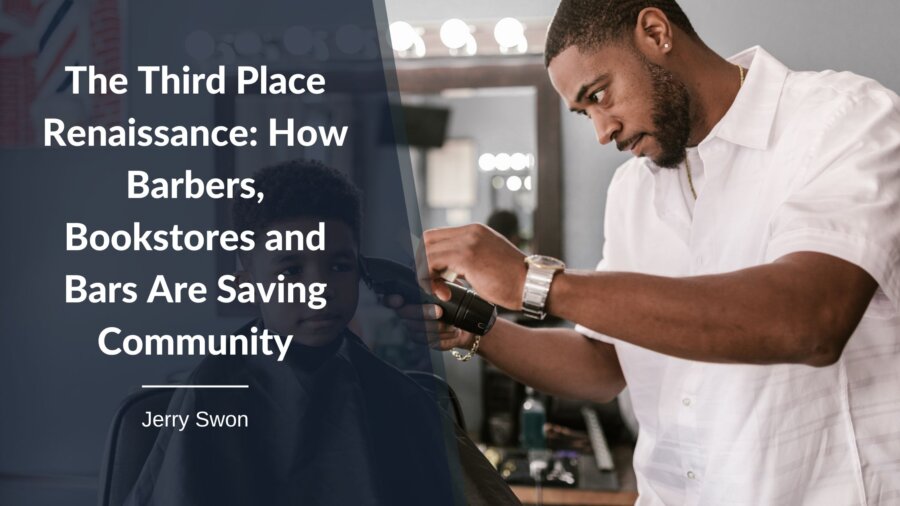
A barbershop in Philadelphia transformed into a hybrid space offering traditional cuts alongside blood pressure screenings and voter registration, recognizing its unique position as a trusted community institution for Black men who might avoid formal healthcare and political systems.
A bookstore in rural Michigan converted its basement into a community kitchen where neighbors teach cooking classes ranging from traditional preservation techniques to international cuisines, creating cross-cultural connections in an otherwise homogeneous area.
In Minneapolis, a brewery established a “radical hospitality” model where customers can pay what they can afford for drinks, creating an economically diverse gathering space in a gentrifying neighborhood.
These innovations showcase how third places are evolving to meet our current crisis of connection. They’re no longer just places to pass time—they’re becoming intentional community infrastructure addressing our most pressing social challenges: polarization, isolation, and eroding trust.
Research consistently shows that regular third place participation correlates with improved mental health, increased civic engagement, and greater community resilience during crises. A study of Hurricane Sandy recovery found that neighborhoods with more active third places mobilized resources more effectively than those with similar incomes but fewer gathering spaces.
The third place renaissance suggests something hopeful about our social future. Despite technological forces pulling us apart, we continue seeking physical spaces where we can simply be together—not as consumers or workers, but as neighbors building the trust and familiarity that healthy communities require.
In a divided era, these ordinary gathering spaces might be our most extraordinary resource for rebuilding the social fabric we all depend on.